tree-service
How Much Does Tree Removal Cost in Boston, MA? 2026 Prices for Tight Lots and Crane Work
How much does tree removal cost in Boston, MA in 2026? Real price ranges by tree size, crane and access fees, stump grinding, permits, and insurance rules.
In This Article
How Much Does Tree Removal Cost in Boston, MA? 2026 Prices for Tight Lots and Crane Work
The tree in your Boston yard is rarely what sets the price. Getting equipment to it, and getting the wood out, is what the invoice reflects. A 60-foot Norway maple in an open Dedham backyard might cost $1,400 to remove. The same tree behind a triple-decker in Dorchester with a six-foot side yard and no rear alley can run $3,500.
Typical Boston-area removals in 2026 fall between $900 and $3,200. Small ornamentals under 25 feet run $350 to $750. Medium trees of 30 to 50 feet run $900 to $1,900. Anything over 60 feet, which describes a lot of the oaks and pines in West Roxbury, Jamaica Plain, and the older Brookline streets, starts at $2,000 and climbs past $6,000 when a crane is involved.
Boston sits at the higher end of national tree removal pricing for the same reasons everything else here costs more. Labor rates are high, insurance for aerial work in a dense city is expensive, and disposal tipping fees add up before a crew has cut anything.
Access Drives the Number More Than Height Does
Every estimator walks the property before quoting, and what they are measuring is the path from the street to the base of the tree and back. A chipper needs about eight feet of clearance. A mini skid steer needs roughly four. If neither fits, the wood comes out by hand in sections carried by two people, and that turns a four-hour job into a full day.
Overhead conflicts are the second half of the calculation. Trees growing into service drops, over slate roofs, above a neighbor's greenhouse, or beside a triple-decker's rear porch stack have to be dismantled piece by piece and lowered on rigging lines. That method costs two to three times what a straight fell costs.
Distance to the truck matters more than most homeowners expect. Dragging brush 120 feet around a house through a side gate adds labor hours to every single load, and on a large tree there are dozens of loads.
When a Crane Makes Sense
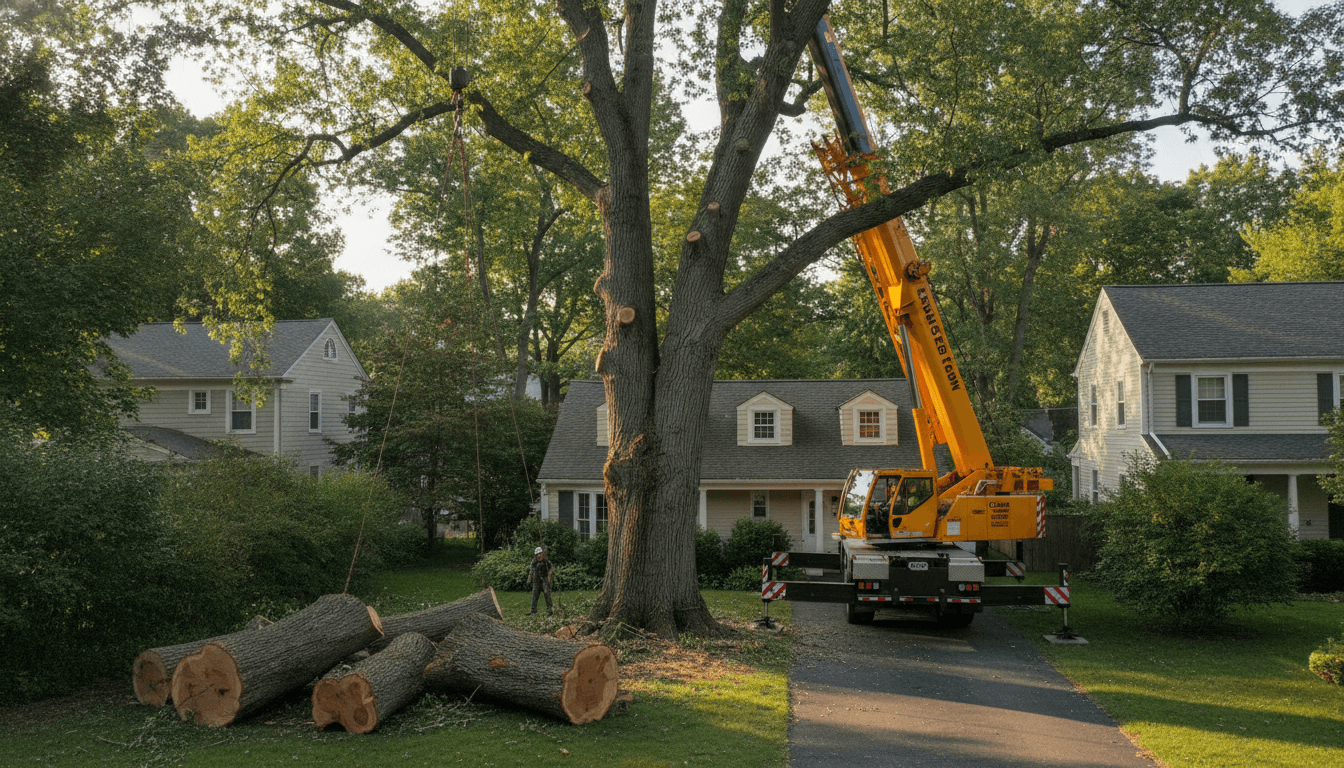
Crane-assisted removals look expensive on paper and often finish cheaper. Bringing in a crane costs $1,200 to $3,500 for a half or full day in the Boston market, but it can cut a two-day hand dismantle down to five hours and reduce the risk of dropping a limb on a slate roof.
Cranes need street space, which in most Boston neighborhoods means a permit and a parking closure. Ask the company whether the crane fee in their quote includes the permit and the traffic control, because those are sometimes billed separately at $200 to $600.
Size Ranges and What They Cover
Under 25 feet, meaning most dogwoods, cherries, and young maples, a two-person crew handles the job in a morning. Expect $350 to $750 including cleanup, with stump grinding quoted on top.
The 30 to 50 foot range covers most street-side maples and mid-life pines in Boston's residential neighborhoods. Prices run $900 to $1,900, and the spread depends almost entirely on whether the chipper can reach the tree.
Above 60 feet you are into mature oaks, white pines, and the big silver maples that were planted across greater Boston a century ago. These cost $2,000 to $4,500 with normal access, and $4,500 to $8,000 when they overhang a structure and need rigging or a crane.
Dead and storm-damaged trees carry a premium of 20 to 40 percent over a healthy tree of the same size. Decayed wood is unpredictable under a climber, so crews use more rigging, work slower, and sometimes refuse to climb it at all, which forces the crane option.
Stumps, Wood, and What Happens to the Debris
Stump grinding is nearly always priced separately. Boston companies charge $100 to $250 for a small stump, $250 to $450 for a medium one, and $450 to $900 for a large multi-stem stump or one wedged against a foundation. Some price by diameter at roughly $4 to $8 per inch with a minimum.
Grinding leaves a pile of chips and soil that fills the hole and then some. Hauling that away costs another $75 to $200, and backfilling with loam so you can seed the spot adds a similar amount. Ask which of those are included before you assume the yard will be flat.
Wood disposal is where quotes quietly diverge. Some companies haul everything. Some leave rounds stacked at the curb, which saves you money if you burn wood and costs you a separate hauling call if you do not. Get it in writing.
Permits and the Tree That Might Not Be Yours
Trees in the public way in Boston are public shade trees, and Massachusetts General Law Chapter 87 protects them. Removing one requires the city tree warden's process, including a posted notice and a public hearing if anyone objects. Homeowners who cut a street tree without that process face fines and replacement costs.
The line between the sidewalk and your property is not always where you think. In many Boston neighborhoods the public way extends several feet past the sidewalk toward the house. If the tree sits anywhere near that boundary, confirm ownership with the Parks and Recreation Department before scheduling anything.
Surrounding municipalities have their own layers. Brookline, Newton, Cambridge, and Somerville all maintain tree protection bylaws that can require permits, replacement plantings, or mitigation payments for removing large private trees. Wetlands buffer zones add a Conservation Commission review on top of that in some parcels.
A qualified local company handles these approvals routinely. Comparing two or three bids from tree services working in Boston neighborhoods is the fastest way to see who already knows your city's process. For related exterior maintenance costs, see our other Massachusetts home service guides.
Licensing, Insurance, and Storm-Chaser Risk
Massachusetts licenses arborists through the Department of Agricultural Resources, and the Massachusetts Certified Arborist credential is the one worth asking about. It is not a formality. Someone who has passed it understands decay assessment, pruning standards, and rigging load limits.
Insurance is the item that can cost you a house. Ask for both general liability and workers' compensation certificates emailed directly from the agency. If an uninsured climber is injured in your yard, or a limb goes through your neighbor's roof, an uninsured contractor leaves the claim sitting with you.
After every nor'easter and every summer microburst, out-of-state crews appear in Boston neighborhoods offering cash prices. Some are competent. Many carry no Massachusetts credentials, no local insurance, and no address you can find in two weeks. Verify before you hand over a deposit, and never pay in full up front.
Timing Your Removal
Winter is the value season in this market. Between January and March, demand drops, frozen ground supports equipment better, and bare canopies make rigging simpler. Companies routinely discount 10 to 20 percent to keep crews working.
Spring and early summer are the busiest and most expensive stretch, driven by storm damage and homeowners noticing dead limbs after leaf-out. Booking in May often means a three to five week wait.
Emergency work after a storm carries premium pricing at one and a half to three times standard rates, and that is reasonable given the hours and the hazard. If a tree is leaning toward the house, call your insurer first. Massachusetts policies typically cover removal only when the tree has struck a covered structure, not when it merely threatens one.
Ways to Bring the Price Down
Bundling work saves real money. A crew already set up on your street for one removal will price a second tree, a pruning job, or a neighbor's overhanging limb at a fraction of what a separate visit would cost. Talk to the abutters before you book.
Flexibility on the date is worth 10 to 15 percent. Telling a company you can take any day in the next six weeks lets them slot you between larger jobs, and most will trade a discount for that.
Keeping the wood cuts hauling and tipping fees. If you have space for rounds along a fence line and a use for them, ask for a price with disposal removed. On a large oak that adjustment can be $200 to $500.
Questions Boston Homeowners Ask
Does homeowners insurance pay for tree removal in Massachusetts?
Usually only after the tree falls and damages a covered structure, and most policies cap removal at $500 to $1,000 per tree. A healthy tree removed as a precaution is almost never covered.
Do I need a permit to remove a tree in Boston?
Not for a tree fully on private property in Boston proper, but you do for any public shade tree in the right of way, which requires a hearing under state law. Neighboring towns including Newton and Cambridge have their own private tree bylaws, so check before scheduling.
Why is my quote so much higher than my neighbor's was?
Access, almost always. A rear-yard tree with no vehicle path costs far more than a front-yard tree the chipper can park beside, even when both are the same species and height.
Is stump grinding included in the removal price?
Rarely. Budget $100 to $900 depending on stump diameter, and ask separately about chip removal and backfill, which are usually additional.
When is the cheapest time of year to remove a tree in Boston?
January through March. Demand falls off, frozen ground protects lawns from equipment ruts, and companies discount to fill their schedules.