hvac
How Much Does AC Repair Cost in Boston, MA? (2026 Rates for Triple-Deckers, Brownstones, and Mini-Splits)
AC repair cost in Boston, MA for 2026: diagnostic fees, mini-split and central air part prices, old-building access costs, Mass Save rebates, and licensing.
In This Article
How Much Does AC Repair Cost in Boston, MA? (2026 Rates for Triple-Deckers, Brownstones, and Mini-Splits)
A typical AC repair in Boston, MA runs $200 to $750 in 2026, and the diagnostic visit that starts it costs $95 to $200 on its own. Refrigerant work and motor replacements sit in the middle of that band. Compressor failures and coil swaps run past it, often by thousands.
Boston is an unusual cooling market. The city asks its air conditioning to work hard for maybe eight to twelve weeks a year, and it asks that of equipment installed in buildings that predate air conditioning by half a century. A two-family from 1912 with plaster walls and a boiler in the basement was never designed to hide a duct system, and every cooling decision in that house works around the fact.
That mismatch between old buildings and modern equipment is where most of the money goes. The prices below reflect what Boston homeowners are paying this season, plus the local details that move a quote up or down.
Where the Numbers Land This Season
The service call runs $95 to $200 across most of Greater Boston, higher than the state average because of drive time, traffic, and parking. Companies commonly credit that fee toward the repair, though not always, so confirm it when scheduling. Some shops charge a flat trip fee plus hourly labor instead.
Hourly labor sits around $110 to $200, with flat-rate task pricing the norm for common repairs. A capacitor swap, a contactor, or a drain clear will usually be quoted as a single number. Bigger diagnostic work, particularly on a mini-split with a communication fault, is more likely to be billed by the hour.
Emergency and after-hours rates add $175 to $400 or bill at time and a half. During a three-day stretch above 92 degrees, that surcharge buys you a spot in a queue that has already stretched into next week. Households with medical needs and no cooling at all get moved up by most reputable companies.
Old Buildings Set the Price Before the Part Does
Roughly two-thirds of Boston's residential buildings went up before 1940, and the vast majority of them heat with steam or hot water rather than forced air. No ducts means no easy path for central air, which is why ductless mini-splits have taken over the retrofit market in Dorchester, Somerville, JP, and everywhere else the triple-deckers stand. The repair market has followed the equipment.
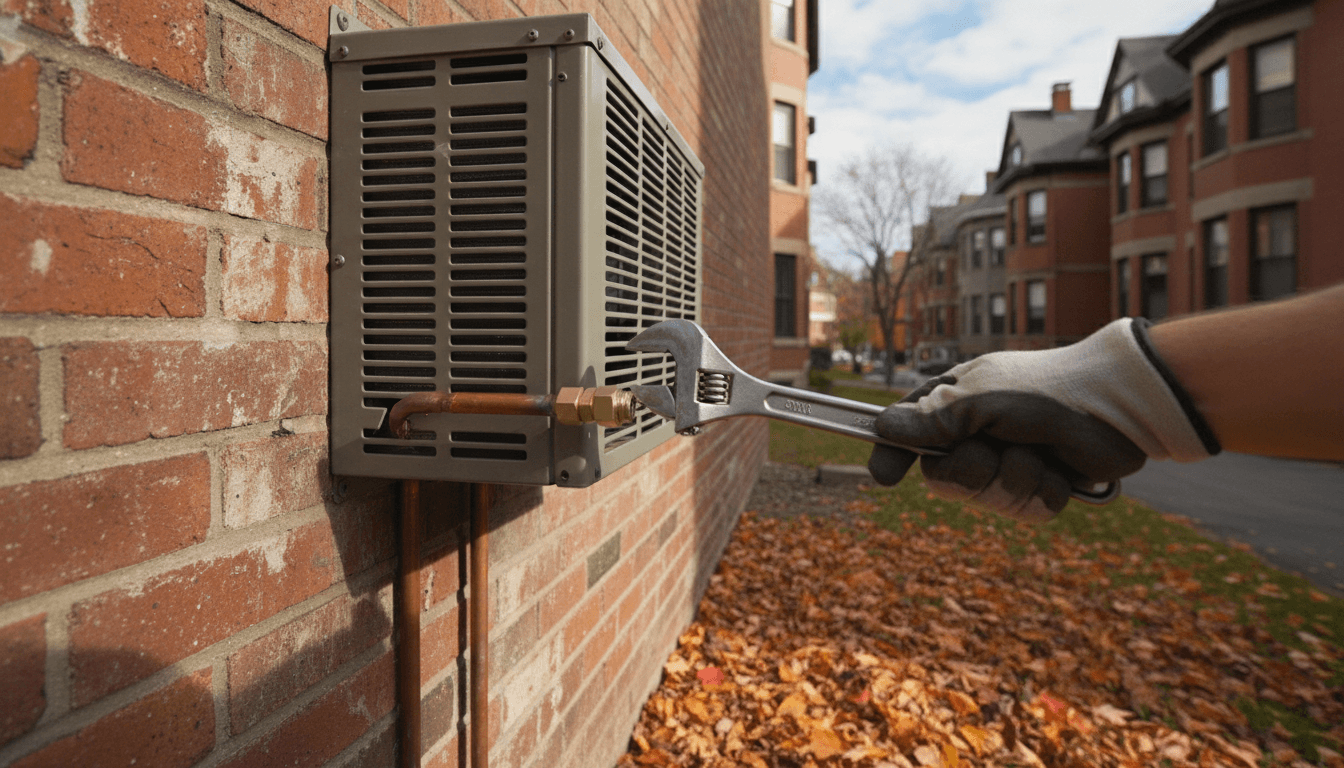
Access drives labor hours in a way suburban contractors never deal with. A condenser on a third-floor flat roof, a line set running up an exterior brick wall, an air handler wedged into a knee-wall attic with 40 inches of headroom: each of those adds time to the same nominal repair. Two identical capacitor failures can differ by $150 purely on how long it takes to reach the unit.
Then there is the street. A crew working in the North End or Beacon Hill needs a parking permit or a metered space held in advance, and a truck that circles for 20 minutes is billing that time to somebody. Contractors who work the dense neighborhoods regularly build this into their pricing rather than surprising you with it.
Condo and multifamily buildings add a layer of approval. Roof-mounted or alley-mounted condensers usually need trustee sign-off before a technician can replace anything, and that paperwork can hold a repair for days in July. Homeowners in three-family buildings should sort out who owns which piece of equipment before the first breakdown rather than during it.
Repair Prices by the Kind of System You Own
The cost of a given failure depends less on the brand than on the type of system. Boston homes run a wider mix of cooling equipment than most cities, from 90-year-old buildings with three window units per floor to new construction with a fully ducted heat pump.
Warranty status matters across all of them. Most manufacturers cover parts for 10 years when the system was registered after installation, and plenty of Boston homeowners never registered theirs. Have the model and serial number ready when you call, and check the warranty before approving anything over $500.
Ductless Mini-Split Repairs
Mini-splits fail differently than central systems. A control or inverter board replacement generally costs $500 to $1,200, indoor unit blower motors run $350 to $700, and a thorough deep cleaning of a mold-fouled indoor head lands at $250 to $600. That cleaning is more common than owners expect, since the blower wheel sits in a damp environment all summer.
Refrigerant work on a mini-split runs $300 to $900 for a leak search and recharge, and flare connections at the line set are the usual leak point. A technician who nitrogen pressure tests before recharging is doing the job correctly. Recharging without finding the leak means paying again by August.
Central Air and Ducted Heat Pump Repairs
Central systems follow a more familiar price list. A run capacitor costs $180 to $425 installed, a contactor $175 to $375, a condenser fan motor $400 to $850, and a variable-speed blower motor $600 to $1,200. Control board failures generally land between $450 and $900.
Compressor replacement is the number that ends the conversation, at $1,600 to $3,400 with labor in the Boston market. On a 12-year-old condenser, that money belongs in a new system. Evaporator coil replacement is nearly as painful at $1,100 to $2,600, and older Boston installs in cramped attics push toward the top of that range on labor alone.
Window and Portable Units
Window units rarely justify a service call, since a replacement runs $180 to $600 and a diagnostic visit alone eats a third of that. Cleaning the coil and swapping the filter solves most performance complaints. Where a technician earns their fee is on the electrical side, particularly in older buildings where three window units on one 15-amp circuit trip the breaker every afternoon.
That circuit problem is worth taking seriously. A licensed electrician adding a dedicated 20-amp circuit typically charges $400 to $900 in a Boston building, and knob-and-tube wiring still lurking in a wall can raise that quickly. Repeated breaker trips are a wiring message, not an air conditioning one.
The Twelve-Week Season and What It Does to Scheduling
Boston's cooling demand compresses into a short window, and it does not arrive gradually. The first 90-degree stretch of the year, often in mid or late June, generates more service calls in four days than the previous eight months combined. Systems that sat idle since Labor Day fail on the first hard run.
That pattern gives you an opening. Booking a spring tune-up in April or May, generally $120 to $300 locally, catches a weak capacitor or a low charge while technicians still have open calendars. Many companies fold that visit into a service agreement that also moves you ahead of non-members during a heat wave.
The same logic applies to the back end of the season. September and October are the cheapest weeks of the year for replacements and non-urgent repairs, and some contractors discount installations to keep crews working before heating season takes over. Waiting until July to address a system you already knew was struggling is the expensive path.
Repair, Replace, or Move to a Heat Pump
Age and refrigerant type decide most replacement questions. Central condensers in this climate typically last 15 to 20 years thanks to the short cooling season, longer than in southern markets, but equipment running R-410A is now on a federal phasedown schedule that keeps pushing recharge costs higher. A large leak on an older R-410A system is a strong replacement signal.
Massachusetts adds a financial reason to consider a heat pump instead of a like-for-like AC swap. Mass Save rebates for whole-home heat pump installations reach into the thousands for qualifying projects, and the zero-interest HEAT Loan spreads the remaining balance over years. Those incentives change annually, so ask each bidder to write the current rebate amount into the proposal rather than quoting a number from memory.
Installed pricing in Boston generally runs $5,000 to $8,000 for a single-zone ductless system, $12,000 to $25,000 for a multi-zone whole-home heat pump, and $8,000 to $15,000 for a central AC replacement where usable ductwork already exists. Urban access, crane rental, and electrical panel upgrades all push those figures upward. A 100-amp panel in an older two-family often needs an upgrade before a heat pump can be added, which is a $3,000 to $6,000 line item of its own.
Licensing, Permits, and Vetting a Boston Contractor
Massachusetts regulates this trade more tightly than its neighbors. Technicians working on refrigeration and air conditioning systems are licensed by the state Board of Examiners of Refrigeration, electrical work requires a licensed electrician, and sheet metal work has its own license. Anyone handling refrigerant must also hold EPA Section 608 certification under federal law.
Contractors doing home improvement work for residential customers are required to register as Home Improvement Contractors, and larger structural jobs call for a Construction Supervisor License. Both are searchable through state license lookups, and a legitimate company will hand over the numbers without hesitation. Permits for equipment replacement come through the local building department, and in Boston that means the Inspectional Services Department.
Insurance verification should come straight from the insurance agency, not as an emailed attachment from the contractor. For anything over about $1,500, collect two or three written quotes that list equipment models, labor warranty terms, rebate amounts, and permit costs. Building your shortlist from licensed HVAC companies serving Boston makes the comparison easier, and our other Massachusetts cost guides cover the seasonal work that follows.
Frequently Asked Questions
What does an AC diagnostic visit cost in Boston, MA?
Expect $95 to $200 during regular hours, which is above the statewide average because of city drive time and parking. After-hours and heat wave calls add roughly $175 to $400 on top of that.
Why are mini-split repairs common in Boston?
Most Boston buildings heat with steam or hot water and have no ductwork, so ductless systems became the standard retrofit. Their inverter boards and indoor blower wheels are the parts that fail most, at $500 to $1,200 and $350 to $700 respectively.
Does Mass Save cover repairs or only new equipment?
Rebates apply to qualifying new installations, not to fixing an existing system. If your contractor is quoting a replacement anyway, ask them to write the current rebate and HEAT Loan terms into the proposal so you can compare offers on the net cost.
What months give me the best pricing on AC work?
Aim for April and May ahead of the first heat wave, or September and October once demand collapses. Fall replacement bids come in lower, and a tune-up booked in either window runs $120 to $300 with no wait for an appointment.